Showing posts with label drama. Show all posts

Rango (2011)

Movies I thought of while watching Rango: High Noon, The Man with No Name Trilogy, The Man Who Shot Liberty Valance, Cat Ballou, Chinatown, Apocalypse Now, Yojimbo, Unforgiven, Fear and Loathing in Las Vegas. Movies I did not think of while watching Rango: Rango.

At what point does a movie stop being its own film, and start becoming a clip show of Hollywood's greatest hits? When John Logan was writing Rango, perhaps he should have put a little less effort into paying homage to so many great films. His basic story is a very interesting one: a lizard that has been kept as a pet suddenly finds himself in an old west town called Dirt, where he has reinvented himself as a gunslinger. That lizard (voiced admirable by Johnny Depp) is the titular Rango, who enjoyed putting on theatrical performances in his terrarium before he suffered an environment change. Shortly after establishing himself as an expert marksmen (accidentally), Rango is promoted to town Sheriff by the Mayor of Dirt (Ned Beatty), a character obviously derived from John Huston's character in Chinatown. But as Rango delves deeper into an investigation about the town's water supply, he finds that the old west may not be the best place for a thespian lizard.

The main problem with Rango is lack of identity. The lead lizard himself is sufferring an identity crisis throughout the film, constantly asking through gloomy voiceover "who am I?" While watching Rango, I sometimes felt as though the movie were asking me "what am I?" The only thing I can say for sure is that Rango is a western, through and through. But where Logan and director Gore Verbinski go wrong is they constantly remind us of past great films, but fail to make Rango anywhere near as good as them. It reaches a point where you ask, "well, why don't I just see those movies?" The highlight of the film comes in the very beginning when Rango is running away from a hawk with another desert creature. This scene is both funny and exciting, and one of the few times that Rango is it's own film. After the scene ends however, the clip show begins.

The animation of Rango is really the saving grace of the film. Every character, though ugly, is beautifully rendered. The most interesting character to look at is bad guy Rattlesnake Jake, voiced by Bill Nighy. His winding, scaly body leads to a tail topped with a Gatling gun instead of a rattle. Every scene with him is thrilling to watch, and in fact were the only times during Rango when my heart actually felt involved in the film. Unfortunately, his scenes don't show up until much later in the film, and they are very scarce even then.

One more important thing that must be stressed is that Rango is NOT a children's movie. Despite being produced by Nickelodeon, this film is riddled with adult humor that children will not understand. On top of that, the humor is not even that funny. You may smirk at an inappropriate comment, but there is very little to laugh at here. Even though the MPAA chose to leave the word "violence" out of it's rating, Rango is littered with it, from claims to cutting off other characters "giblets" to a supporting character who constantly walks around with an arrow through his eye.

Rango is an hour and 47 minutes, but feels a lot longer. It has terrific animation, well crafted action scenes, but an overall slow pace and a very annoying lead character in Rango. Many will find the references to other films endearing and fun, but I found them to be distracting. You are probably better off just watching any of the films I listed earlier. My rating (3/10)

Boy A (2007)


Everyone got into trouble when they were children. Most of the offenses were trivial: breaking a vase, running with scissors, pouring milk on the dog's head. But what of the children who do truly reprehensible things? Things that adults go to prison for. When Jack Burridge (Andrew Garfield) was a little boy, he and his friend Philip killed a fellow student. Sent to trial being known to the public as "Boy A", Jack was convicted and spent the rest of his youth and all of his teenage years in jail. But at age 24, Jack is being released (at the chagrin of all of London), and ready to start life anew. With the help of fatherly social worker Terry (Peter Mullan), Jack finds a place to live and a job delivering packages. He even stirs up a romance with curvy co-worker Michelle (Katie Lyons) which leads to his first sexual experience. All seems to be going well for Jack until an act of kindness brings him under the spotlight, and threatens to reveal his identity.
There is an obvious moral question posed in Boy A. Are children who do evil things inherently evil? Do they remain in the same state throughout their lives, or can their indiscretion be chalked up to naivety? As we watch Jack on a personal level, we see that he is a being fully capable of kindness and sensitivity. We see him stand up for a friend and fall into love like a newborn pup with Michelle, and we cannot help but like him. We also get a look into his past as a neglected child who is frequently bullied at school. He is clearly determined to prove that he is a changed person. He changed his name from Eric to Jack upon leaving jail so that he can literally become a new man. But not all of London can see Jack on the level that we are. They just know about what he did in the past, and for them, that's all they need to know. Unfortunately, we can't see how Jack's friend Philip fairs outside of jail, because he committed suicide.
The titular Boy A is played brilliantly by Andrew Garfield. You may recognize him from the 2010 masterpiece The Social Network and photos as the new Spider-man in the upcoming franchise reboot. Boy A was Garfield's first ever leading film role, and it is nothing short of astonishing. As a man forced to leap from child to adult without that learning stage in between, Garfield plays the role with just enough boyish charm to really seem like somebody who never grew up properly. He is helped by a strong supporting cast, specifically Peter Mullan as Jack's social worker. Every scene between the two characters is exceptionally engaging, as you really feel a strong connection between these two actors.
Boy A is not always an easy film to watch, but it is definitely a rewarding experience. Because of the intriguing dilemma brought up in Mark O'Rowe's screenplay, this film is sure to stir up some debate amongst intellectual circles. At 106 minutes, Boy A leaves at a good moment where we don't even begin to lose interest in Jack's struggles. You will be invested in this film all the way up to the emotional finale. My rating (8/10)

The Fighter (2010)

Family is the most important thing in the world. Families support us, make us feel accepted, and always look out for our best interests. But for Mickey Ward, family is exactly what's holding him back. A struggling boxer in Lowell, Massachusetts, Mickey (Mark Wahlberg) paves streets while in between losing fights. He is coached by his brother, Dicky Eklund (Christian Bale), the former "pride of Lowell" who once knocked down Sugar Ray Leonard in a match, but is now just a disappointing crack addict. Dicky claims to know exactly what is best for Mickey, helping him pick fights and devise strategy, but more often than not, Mickey just ends up with a bruised face and hurt pride. When Mickey starts dating a strong-minded bartender named Charlene (Amy Adams), his family dynamic is disturbed as she encourages him to stop working with his brother and manager mother and start training more seriously. Mickey has to reluctantly decide what is truly the most important to him: his family or his career.
The Fighter has been a passion project of Mark Wahlberg for many years. Since 2005, he has tried to get the true story of Mickey Ward on the big screen. Now that he finally has, he can be proud of his final work. Mickey is not a particularly interesting character. He could be, if only he was allowed to speak more often in his motor-mouthed family. He is consistently drowned out by brother Dicky, mother Alice, and his seven sisters who are as talkative as their hair is tall. Even after he meets Charlene, she is the one that does most of the arguing with his family. But Wahlberg still delivers a terrific, nuanced performance, using body language as a major means of communicating. He frequently gets the look of a small child who knows he is being overshadowed by his older siblings. This seems rather fitting, because Wahlberg's terrific performance is greatly overshadowed by the actor who plays his older brother, Christian Bale.

Bale is simply astounding in his portrayal of down-for-the-count Dicky. Dropping all the muscle and weight he had put on for The Dark Knight (which he will need to put back on for the sequel filming this year), Bale perfectly achieves the look of a boxer turned crack addict. The way he handles his body through movement is as precise as a well timed left hook. Bale should be a favorite to win Best Supporting Actor at the Academy Awards. Another strong competitor for an Oscar should be Melissa Leo, who is brilliant as Mickey and Dicky's mother, Alice. It is a guarantee that at some point you will want to tear her hair out, because she is just so believable as the cocksure head of the family. Leo's performance cuts deep into the audience, as her character cuts deep into Mickey. When she spars with Amy Adams' Charlene, the two create a scathing atmosphere that permeates the whole room.

The Fighter is very much a performance driven film. In fact, without all the exceptional performances, The Fighter would be a rather mediocre, run of the mill sports drama. Director David O. Russell does a good enough job behind the camera, but never really quite takes the film to it's heights. The boxing scenes are done from spectator point of view through a granier lens, and they are not as exciting as they could have been. The film also ends without showing a single one of Mickey's fights with Arturo Gatti, which are arguably the best boxing matches in history. There is a significant emotional conclusion to the film, but physically, there was a severe lacking.
Come Oscar season, The Fighter will get serious consideration for all the top awards, and it makes sense that it would. It is certainly one of the best films of 2010. The acting through and through is superb and deserves recognition. One should hesitate before granting it any writing or directing nominations though, as both were pretty pedestrian. If you can truly appreciate great performances, you will really enjoy this film. My rating (7.5/10)


The Social Network (2010)


Our way of living has been defined by many key creations in history. Thomas Edison invented the lightbulb. Alexander Graham Bell invented the telephone. Mark Zuckerberg invented Facebook. One may find it strange that Zuckerberg would be included on a list of great inventors, but think about this for a moment. Before Facebook, to write on somebody's wall meant to take a pen and draw on some one's house. "I have to pick my strawberries" was something only a farmer would say. Making friends involved going out to social events and speaking with people in the flesh. Now, with the click of a mouse you can connect with hundreds of "friends", like their status, play bejeweled, and spend a good chunk of your day "creeping" on people's profiles. Our every day lives and even our language have been updated, and it is because of Mark Zuckerberg, organizer of the biggest social gathering in human history.


The Social Network revolves around the birth of Facebook back at Harvard University in 2003. Jesse Eisenberg (Zombieland, Adventureland) plays Zuckerberg, a socially inept genius with one friend in roommate Eduardo Savarin (Andrew Garfield). After being dumped by his girlfriend in the first scene, Zuckerberg takes to the internet to create a website as way to get some revenge. No it's not Facebook yet, but the website he creates becomes so popular in just four hours, it manages to crash Harvard Univesity's server. Impressed, twin brothers Cameron and Tyler Winklevoss (Armie Hammer in both roles) commission Zuckerberg to help create a website they have been thinking of. A social networking site. Zuckerberg agrees, but rather than help them, he designs his own website with the help of Savarin, and thus Facebook is born. But the journey to fame is no easy walk, and Zuckerberg's life becomes filled with controversy.


The Social Network just might be a perfect movie. Writer Aaron Sorkin will more than likely earn an Academy Award for Best Adapted Screenplay (the book being "The Accidental Billionaires" by Ben Mezrich). Expertly crafted, Sorkin brings the audience a witty, intelligent, cocky, quick, and sharp film, a perfect parallel to the main character Zuckerberg. Along with this, Sorkin manages to take a rather uninteresting plot and shape it into an intense two hour heart pounder that you will not want to see end. This film is driven heavily by dialogue, yet it moves with the pace of a summer blockbuster, due in part to the astute direction from David Fincher.


Jesse Eisenberg is flawless as the flawed Facebook creator Mark Zuckerberg. Never hitting a wrong note, Eisenberg captures Zuckerberg's awkward, work driven, condescending demeanor in every frame. It should not surprise anyone to find Eisenberg's name in discussions for Best Actor come Oscar season. But the real surprise coming from The Social Network is the supporting performance from practically unknown Andrew Garfield as Zuckerberg's only friend Eduardo. Garfield is outstanding as the modest, business-headed CFO of Facebook. Eduardo's story is tragic, and Garfield's performance draws out heaps of sympathy from the audience. A Best Supporting Actor nomination could be on the horizon for this young actor, and it would be well deserved. It's also worthy to note that Justin Timberlake gives a very strong performance as Napster creator Sean Parker, who infiltrates his way into Facebook and turns Zuckerberg against his friend Eduardo.


But the part of The Social Network that audiences will find to be the most stimulating is analyzing the character of Mark Zuckerberg. This is a man not driven by money or fame. He does bad things, but is not inherently a bad person. At one moment he will commend his friend Eduardo and in the next breath he will demean him, both sentences being in the same tone of voice. His motivations are never explained, because it is more than likely Zuckerberg himself does not understand them. Are his actions later in the film defined by Parker interfering in his life? Is Zuckerberg legitimately a bad person? If money and fame do not motivate him to perfect Facebook, then what exactly does? These are all difficult questions, and you will have fun finding the answers.


It should be noted that although most of the basic events that take place in this film are real, the circumstances surrounding them have been greatly exaggerated and falsified. The writers of the book and film respectively took creative license in order to make a more entertaining story, which is what the business is all about. However, this does not take away from the impact of the film at all. The Social Network will stand as a defining film of our generation for years to come. My guess is, you will "like" The Social Network. My rating (10/10).

Kick-Ass (2010)

Being a superhero is as close as a fictional character can get to becoming a celebrity. Many people forget the names of actors and actresses, but nobody is going to dig through their mind trying to remember who the guy in the bat suit is. This easy notoriety is the reason so many of us fantasize about having superpowers (and don't pretend that you don't). So, how come nobody has tried to be a superhero? This is the exact question Kick-Ass' protagonist Dave Lizewski asks his two nerdy friends as they hang out in their local comic book store. If you ask me, it's to prevent movies like Kick-Ass from being made.
Dave Lizewski (Aaron Johnson) is a textbook nerd. He has big glasses, a cracking voice, and is utterly invisible to the popular crowd at school. His favorite hang out spot is a comic book store with his two friends that do nothing to improve his image. Fed up with being useless in a world run by crime, Dave decides that what we really need is a superhero. Equipped with absolutely no combat skills, a green wet suit, and some clubs, Dave assumes his alter-ego as Kick-Ass. Little does Dave know that he is not the only superhero on the block. After narrowly being killed by thugs, Dave is saved by Big Daddy and Hit-Girl (Nicolas Cage and Chloe Moretz), a father-daughter team set on seeking vengeance for a past atrocity by crime lord Frank D'Amico (Mark Strong). Soon after, Dave discovers that being a superhero may not always be worth the fame.

Kick-Ass is based on the graphic novel of the same name by Mark Millar. I have not read the graphic novel, but I have no doubt that it was much better than this film. There has been a lot of controversy surrounding Kick-Ass because of Chloe Moretz's role as Hit Girl. There is apparently something about a 13 year old sporting a trucker's foul mouth and a tendency towards bloody violence that just did not sit right with most parents. Well, I'm no parent. Hit Girl was one of the only good things about this movie. As a source of several of the few laughs to be had, Chloe Moretz does an apt job of keeping this otherwise lackluster film afloat. But the real treat was seeing her interact with her character's father, Big Daddy, played brilliantly by Nicolas Cage. Cage and Moretz bring undeniable chemistry to the screen, and are an absolute delight to watch. The best scene in the entire film comes when we first meet Big Daddy and Hit Girl as their plain clothes selves, Damon and Mindy Macready. Former cop Damon is teaching his daughter how to deal with pain...by shooting her in the chest while she wears a bullet proof vest. This scene gave me hope that this movie would have many more brilliant scenes to come. Unfortunately, this movie was not called Big Daddy and Hit Girl. It's Kick-Ass. So let's discuss the titular hero.

Do you know how fun it is to watch somebody who cannot fight, try to beat up a group of criminals? You may think it's kind of funny for a few minutes, but after a while it just becomes kind of sad. Well that is how I felt watching Kick-Ass. First of all, the character of Dave Lizewski was one that I had no feelings towards. Aaraon Johnson was not doing enough to create a main character that was worthy of my sympathy. I did not care about him. Because of this, my interest in the character was void. There may have been some hope when he became Kick-Ass, but I soon discovered another problem. It is just no fun to watch somebody flail their arms around in a green wet suit. I understand that his inability to fight was the point, but that doesn't make it a good point. Every film has two basic sides: the point (message, theme, etc) and the entertainment (emotional responses). You can have effective entertainment without having an effective point, but you can NEVER have an effective point without effective entertainment. You can make a film about the most important subject ever, but if I don't like the way you tell the story, than why should I care? Sadly, Kick-Ass does not gain fighting skills throughout the course of the film, so any scene with him is just as monotonous as Johnson's voice over.

Well maybe Kick-Ass shouldn't be graded on its performances. After all, it has been advertised as a high-octane violence fest. Surely, the action sequences are top notch and worth the films downfalls. Well, don't be so sure. There are actually relatively few fight scenes in Kick-Ass, and there are even fewer that are actually fun to watch. The best fight in the film belongs to Big Daddy. It was well choreographed and excellently filmed. Unfortunately, it lasts only about 20 seconds. The majority of the fighting in the film is done by Hit Girl, and though her moves are eye-poppingly exciting the first few times around, they became rather stale near the end. I felt like I was watching the same scene over and over again.

Kick-Ass is a movie that should have remained a graphic novel. It's protagonist did not transfer well to the screen, and neither did it's style. Perhaps if the film focused more on Big Daddy and Hit Girl it would have been a lot better, but that probably would have upset the fanboys of the graphic novel. I cannot recommend this film to anybody over the age of 30 or under the age of 17. This film is perfect for the college crowd but will not sit well with anyone else. And I have a feeling that in a couple of years, not many people will even remember it. My rating (4/10)

Moon (2009)


Sam Rockwell is perhaps one of the most under-appreciated actors working today. Despite excellent turns in The Green Mile and Matchstick Men (just to name a few), Rockwell never received the real notoriety he deserves. Now at age 40, Rockwell may have finally found the role which will grant him A-list status. Moon is the futuristic story of Sam Bell, a man who has been stationed on the moon in order to collect a valuable energy source. With two weeks left on his three year contract, Sam is looking forward to returning home to see his wife and daughter. But just as his trip home looms around the corner, he begins noticing some strange occurences going on around his solitary station. With robot companion GERTY (voiced by Kevin Spacey), Sam attempts to unravel the mystery behind his mission.

Moon is the debut film for writer/director Duncan Jones, who was formerly famous for being David Bowie's son. Jones' ideas are familiar enough to any science fiction fan. The ideas of solitude and dehumanization are prevalent throughout the film, which seem to be staples of the genre. But Jones handles these tried and true ideas with care, and uses apt direction to bring them to life. His frequent use of wide, expansive shots is key to showing Sam's loneliness. In one particularly powerful scene, Sam drives out to the middle of a wide open range and begins to cry for his home. Jones brilliantly places the camera in a position that shows Sam's vehicle all by itself on the moon's surface, with Earth looming in the background. As a first time writer, Jones also understands that most audiences do not like to be kept in the dark too long about a film's mystery. By revealing the "secret" halfway through the film, we were able to appreciate Moon as a character driven powerhouse.

But the true reason anybody and everybody should see Moon is Sam Rockwell's beautiful performance. As essentially the only actor on screen for what must be 95% of the film, Rockwell is burdened with keeping this movie afloat for the 97 minute runtime. Masterfully, Rockwell tackles this chore with ease, turning this one man show into Academy Award material. Unfortunately, Sony Pictures decided to not send this film out for consideration, a move which has caused much uproar in the film community. There is no doubt that Rockwell would have been nominated for Best Leading Actor, and he maybe could have won,

Just because Sony snubbed this film does not mean you should too. Moon is one of the best science fiction films of the decade, giving new life to old conventions of cinema. This film should be at the top of your movie rental list. My rating: (9/10)

Inglourious Basterds (2009)


"We ain't in the prisoner-takin business. We in the kiliin Nazi business. And cousin, business is a-boomin". This line, spoken by Brad Pitt as Lieutenant Aldo Raine, should just about sum up Quentin Tarantino's Inglourious Basterds. The "We" in question: eight Jewish-American soldiers (accompanied by German defect Hugo Stiglitz, played by Til Schweiger) that have vowed to deliver 100 Nazi scalps each to their leader, the aforementioned Raine. Their group's name: the Inglourious Basterds. Don't ask about the spelling. It's never explained. These men have made quite the impression on the Third Reich, angering Hitler himself and landing on the radar of "the Jew hunter" Colonel Hans Landa (superbly played by Christoph Waltz). Showing no fear for possible death, the Basterds join a mission called Operation Kino. The mission, being carried out with the help of German actress Bridget Von Hammersmark (a traitor to her own country, clearly), involves suicide bombing a movie theater that happens to be inhabited by the four major heads of power in the Third Reich, including Hitler. Little do the Basterds know that while they carry out their plan, the owner of the movie theater, Shoshanna Dreyfus (Melanie Laurent) has her own scheme in the works. When Dreyfus was a teenager, her family was murdered by Hans Landa, and she considers this to be the perfect time for revenge. Will either parties succeed in their mission? History says no, but Quentin Tarantino didn't set out to make a historically accurate film.

THE REST OF THIS REVIEW IS LOCATED AT http://www.7tavern.com/4/28/1264

Public Enemies (2009)

From the first scene of Michael Mann's Public Enemies, I knew the ride would be bumpy. As John Dillinger (Johnny Depp) is led through the front gates of a prison, the camera jostles up and down in motion with the characters walking, but with extreme exaggeration. After a few lines of mumbled dialogue the cameraman evidently has a seizure while Dillinger and his jailhouse friends stage a breakout. As Dillinger and his buddies, including John "Red" Hamilton (Jason Clarke) and Homer Van Meter (Stephen Dorff), exit with guns blazing, not a moment of it is comprehensible through the frenetic cinematography and abrasively loud gunfire. This is just the beginning of the numerous complaints I have about Public Enemies.

In the year 1933, suave criminal John Dillinger is running wild in Chicago. Robbing banks in "a minute and 40 seconds. Flat." has made him public enemy number 1 for J. Edgar Hoover's (Billy Crudup) FBI. With Dillinger gaining popularity in the public eye for his easy-going demeanor, Hoover is desperate to get the criminal to the electric chair. So he hires Melvin Purvis (Christian Bale), the man who hunted down and killed Pretty Boy Floyd, to spearhead the manhunt for Dillinger and his associates, including notorious Fed killer Baby Face Nelson (Stephen Graham). But the bulk of the story follows Dillinger in his troubled life, trying to balance his "work" with the love of his life, Billie Frechette (Marion Cotillard).

The number one reason Public Enemies fails is it's writer/director Michael Mann. As I described in my opening paragraph, Mann's choice of cinematography was a poor one. Choosing to use an HD handheld video camera, Mann probably wanted the viewer to feel as though he was standing next to John Dillinger. Instead, I felt like I was watching a cheap re-enactment put together for the History Channel. By placing the camera directly into the actor's faces, a sense of claustrophobia sets in, and it makes sitting still very difficult. If that were not bad enough, during the gunfights, understanding what is being shown to you is near impossible. The camera moved so fast and so unsteadily that I would think one character was being shot, and then later in the scene he'd appear again perfectly fine. After just a few seconds of this home video-esque style, my head began to hurt and I started to feel woozy. Throw in the fact that Mann made the gunshots as loud as a sonic boom each, and I couldn't listen to the film either. During a scene showing the famous battle of Little Bohemia, after 20 seconds I had my head buried in my chest, eyes shut, with my hands over my ears, because I was becoming so uncomfortable. My sight and sound, the two senses one needs to enjoy a film, were actually rejecting Public Enemies.

If that weren't enough, Mann's writing skills were lacking greatly as well. (Though he shares billing with 2 other people, it's easier to just write his name). Though full of slick conversation, Public Enemies just doesn't make sense at some points. For example (nothing I'm about to say is a spoiler): the first 40 minutes of the film, the FBI is looking everywhere for Dillinger, and they frequently say they have no leads. Then in the next scene, while Dillinger is in a hotel room with Frechette, the FBI busts down the door and arrests him. That's quite the magic trick Mr. Mann, but how is it done? How could it be that the FBI can go from clueless to busting down his door in a matter of one scene? Well he doesn't explain it, so keep dreaming. For all I know, they did discuss it briefly, but who knows through the mumbled voices of almost every actor in the film. Anybody who has seen a film with Christian Bale knows that he has mastered an American accent. However, the chore of speaking in a southern accent proved too great the task for him. In one of his worst performances, Bale can't quite speak clearly enough to help out the audience. As a friend of mine affectionately put it, "it was like he borrowed his accent from Foghorn Leghorn, and he forgot to use it sometimes". Couldn't have said it better myself. The starpower of Johnny Depp, who tries very hard to save this sinking ship by giving a good but forgettable performance, can't distract us from the fact this film's screenplay is awful. It is painfully slow during most scenes, and then frantically hurried in scenes where valuable information is being thrown around. No medium was ever found in the script, and so the transfer to the screen was just as bad.

Since Mann chose to "put us in the action" rather than tell us an actual story, Public Enemies was an all out failure. Even if I were to forgive the flaws of the screenplay and most of the acting, I'd still give this film a scathing review because of it's direction. It just goes to show that a cast list alone cannot make a film good. You know what I would like to see? A film based on Baby Face Nelson, played by Stephen Graham again. I felt Graham gave the best performance of the film, and I'd like to see him again in the role. That movie might be good. Public Enemies, not so much. My rating (2/10)


Milk (2008)

"My name is Harvey Milk, and I'm here to recruit you!" This quote may not mean anything to most of us today, but when spoken by Harvey Milk himself in 1970s San Francisco, this was a battle cry that meant hope for homosexuals everywhere. To this day, the issue of homosexuality has been prevalent in our society. Great strides have been made to settle the dispute, but none have birthed a final conclusion. Intolerance of homosexuals became a past time for some Americans, and Harvey Milk was the man looking to find those people another hobby.

Milk is the true story of Harvey Milk (Sean Penn), the first openly gay man elected to a public office. Forced out of New York because of his inability to live his lifestyle freely, Harvey took to the road with his lover Scott Smith (James Franco) in search of a haven for homosexuals. The two arrived in San Francisco only to discover just as much prejudice crawling through the city as anywhere else. Determined to help the world realize that all men are created equal, Harvey runs for office multiple times but comes out on the losing end. Despite losing Scott because of the chaos of politics, he kept pursuing office and eventually won a seat as City Supervisor in 1977. Contending with the views of fellow Supervisor Dan White (Josh Brolin), Harvey now had to face a huge threat that endangered the jobs of millions of homosexuals: Proposition 6. Led by State Senator John Briggs, Proposition 6 called for all homosexual teachers at public schools to be fired in order to prevent them from teaching their students to be gay. This absolutely absurd claim sparked huge uproar in the gay community, specifically from Harvey Milk. Chronicling his life from his move to San Francisco to his murder (not a spoiler, as both his death and murderer are revealed about 4 minutes into the film), Milk is a fantastic film that teaches us about the life and teachings of this pioneer in history.

It is almost impossible to determine where one should begin to discuss Milk. With such flawless execution in every aspect of the film, it seems unfair to start one without talking about the other. Writer Dustin Lance Black, who received an Academy Award for his Best Original Screenplay, did a terrific job of not simply stating facts about Harvey Milk's life but telling a story that dug emotions from the deepest trench of my soul. To admit something about myself for a moment, I am not exactly what you would consider a "sympathizer" of the homosexual lifestyle. However, Black's perfect blend of realistic drama and occasional humor (Dan White: Can two men reproduce? Harvey Milk: No, but God knows we keep trying!) made me connect with each and every character and start to think of things in a new light. Director Gus Van Sant complimented Black's writing beautifully with an eloquent style that was not in the least bit showy. Subtle and simple camerawork did not fancify the story but simply enabled it to be told in a direct matter for the purpose of entertainment and enlightenment. Van Sant, whose films have been hit and miss (a shot for shot remake of Psycho counts as not just a miss, but a complete and utter misfire that made Alfred Hitchcock weep in his grave), is at his creative best here by being as least creative as possible.

The piece de resistance of Milk is the one who not only brought the words, but the man, to life. I am referring to Sean Penn, who won his second Academy Award for Best Leading Actor for this role. My initial reaction to Penn winning this award was one of disbelief and anger, because although I had not seen the film yet, I had heavy doubts that he could have been much better than Mickey Rourke in The Wrestler. Having seen Milk, I can say both men were equally worthy of winning the award, and the reason it was granted to Penn was probably due to the fact that Hollywood is a liberal place. This does not take merit away from Penn's performance, which was nothing short of outstanding. His contribution mixed with Van Sant and Black brought the era to life and put me right in the center of the action. What is perhaps most surprising about Milk is that there were a number of supporting performances that were just as praise-worthy as Penn's. Josh Brolin delivered a very powerful performance as Harvey Milk's executioner Dan White, earning him an Oscar nod for Best Supporting Actor. White, a man bent on protecting the sancitity of traditional family life, perhaps even confused about his own sexuality according to Milk, feels his world begin to unfurl as he starts losing support and he watches Milk start to gain some. His morals and ethics are shook to the core, and Brolin displays them easily for us to see. But to just give Brolin a nomination for Supporting Actor seems unfair to Emile Hirsch and James Franco, who both gave exceptional performances. As Harvey Milk's close political advisor and fellow gay activist Cleve Jones, Hirsch encapsulates the role and helps keep the movie afloat in scenes that in other hands would have sunk. The most unexpected performance of Milk was that of James Franco, whom I have never seen in a good dramatic role. I was shocked to find that while watching the film I had completely forgotten it was Franco and I just felt like I was watching Harvey Milk and Scott Smith. Perhaps there is a future for him in serious films after all.

Admittedly, my general views on homosexuality have not changed much since watching Milk, but I have gained a better understanding of the situation. The very idea that this film resonated with me at all should give you an idea of how powerful it's message was. One can only wonder that if this film was released a few weeks earlier, would the recent Proposition 8 have passed in California? Something tells me that if everybody watched this film, whether the ideas stuck or not, the immediate reaction would have been to vote "No". This is all a relative thought, however. If you are a strict, God-fearing person, this movie will not affect you at all probably. But if you are like me and your feelings about homosexuality come from your own mind rather than a book, you may be more inclinded to succumb to the bias of Milk.

Clocking in at just over 2 hours, I was never bored with Milk and felt that I could have watched it again immediately afterward. To those of you who are concerned about watching men kissing other men, I assure you that at no point does the film become uncomfortable to watch, as long as you have a mature mind about you. Whether you watch Milk as a historical text or a vessel of entertainment, you are guaranteed a terrific experience from a truly brilliant movie. My rating (10/10)

Adventureland (2009)


In 2007, director Greg Mottola made a huge dent in the world of comedy with the hit Superbad. With the assistance of writers Seth Rogen and Evan Goldberg, he delivered one of the funniest films of the year and still kept it sincere underneath the loads of vulgar language. In 2009, Mottola went out on his own and wrote and directed the film Adventureland, a project probably very close to his heart because he worked at the real Adventureland long ago. For his sake, I hope this was not an account of his actual experiences there. Not only was this film about as funny as stubbing your toe on the refridgerator, it was overrun with whiny characters that pulled no sympathy from me.

It's 1987 and James Brennan (Jesse Eisenberg) just graduated from college. Before attending Graduate school at Columbia, James wants to spend some time in Europe in hopes of losing his virginity to an easy foreign girl. But when the cost of his trip increases unexpectedly, James is forced to find himself a summer job to pay for the difference. Enter Adventureland, the local amusement park where James' friend Frigo (Matt Bush, the kid from the AT&T commercials, and the only funny part of this film) works. After a brief interview with park manager Bobby (Bill Hader) and his wife Paulette (Kristen Wiig), James begins his thrilling career as a game shack attendant. Life looks bleak for James until he is spotted by Em (Kristen Stewart), another game attendant. The two spark up a friendship that soon turns into romantic feelings for James. But Em's chaotic home life and an attractive musician mechanic named Connell (Ryan Reynolds) jeopardize James' chance of making this summer one he will remember forever, in a good way at least. Falsely advertised as a comedy, Adventureland is a drama chronicling the life of a post-graduate loser in Reagan era Long Island.

Adventureland did have one aspect going for it in it's favor. It was a realistic film in how people, specifically younger generations, interacted with each other in their awful job environment. The awkward and somewhat gloomy nature of these poor souls was a truthful account, so in that respect Mottola did a great job at writing. However, this brings up a serious problem in the film. Real life is not all that funny. In Superbad, the friendship between the two main characters was real, but events in the film were heavily exaggerated to accommodate the comedy of the film. In Adventureland, everything that happened was practical and thus much less funny. Mottola left little room for comedy and instead put heavy effort into developing his characters. In a dramatic film, character development is key. There needs to be a significant amount of it in order to draw an audience in. However, a comedy does not need nearly as much attention put in to the characters. In a good comedy, such as Superbad, the very beginning of the film introduces us to exactly who our main protagonists are. As the film progresses, subtle actions inside the comedy reveal more and more about the characters, but we are never force fed the material. Mottola takes this short 5 minutes of character introduction and stretches it into a full hour. Because of this, there is no light-hearted interlude between the moments we meet our friend James and the main issue of the film. It is drama through and through, and I was looking for a comedy.

Perhaps the biggest disease that Adventureland suffered from was the fact that it was a character driven film with boring characters and lackadaisical actors. Jesse Eisenberg plays the soft spoken intellectual James in a static way that is reminiscent of Michael Cera. Both emit an air of pathetic awkwardness, and neither ever really raise their voice beyond a certain level. The only difference is that Michael Cera is actually funny. Line after line Eisenberg delivers with the same "enthusiasm", and never once did he bring a smile to my face. Much like Paul Rudd's character in I Love You, Man was embarrassing to watch, Eisenberg overplays the quirkiness of his role and never shows the maturity that his character supposedly gained. The lone bright spot as far as performances go belongs to Kristen Stewart, who may have actually been too good for her role. The confusion and mayhem that was Em's life is brought forth with stunning strength though Stewart's performance. I say she may have been too good for this role because since everybody else was so awful and she was so spot on, the gap between was uncomfortably recognizable. However good of a job Stewart did though can be overlooked by the fact that she too, has not a single comedic line in Adventureland. So far, we have a comedy with two main characters. One is pathetically unfunny despite his best efforts, and the other is straight-laced and meant to amp up the drama. Forget good performances, somebody say something funny! It was here that the supporting cast contributed hugely to the film. Matt Bush as James' pestering friend was by far the funniest aspect of Adventureland, but was unfairly underutilized. I have seen Bush in a few TV commercials and I was glad to see that he transferred well onto a big screen. His future in the film industry will hopefully long, despite his upcoming project, Halloween 2. And of course, Bill Hader and Kristen Wiig deliver as always but are, like Bush, rarely on screen. Martin Starr, as James' game shack mentor Joel, provides little to nothing to film, and may as well have been dropped from the script entirely.

It can be argued that Adventureland was not meant to be a comedy in the vein of Superbad but rather a touching coming of age story. This statement I can live with, but respectfully disagree. This film has been marketed vigorously as a hilarious follow-up to Superbad so that is exactly what I expected. Marketing this film as a comedy makes about as much sense as marketing Schindler's List as a great date movie. But judging Adventureland as a coming of age tale does not help it much. Because of the dismal acting and irritating characters, the journey into manhood didn't interest me in the slightest. The final resolution to the film is predictable and conjured not a single emotion from me. The characters themselves showed little emotion to any situation presented to them. They simply looked bored, and that made me bored with them.

Adventureland is a very long 107 minutes that is only good for a few chuckles and one solitary worth while performance. Greg Mottola has fallen victim to the sophomore slump, falling well short of the expectations brought about by Superbad. To those of you who may complain that I am being unfair by comparing this film to Superbad, let me say this. Adventureland as a lone film was boring, not funny, and a waste of $8. My rating (2/10)


Se7en (1995)

Lust, gluttony, greed, sloth, envy, wrath, and pride. These are the seven deadly sins as written by Pope Gregory the Great in the 6th century, updating the work of Evagrius Ponticus in the 4th century. These cardinal vices are said to be the seven most objectionable sins a man can commit. However, for the 15 centuries this list has been around, mankind cannot seem to abide by the rules. Millions and millions of people everyday, including myself, indulge in these sins, and feel no immediate consequences (what awaits us in the afterlife, we can never be sure). Perhaps we should look upon this as a blessing, for if everyone in the world that committed one of these sins was chastised for them at once, there would not be much of a population left today. For this, we should thank our lucky stars that we do not live in the world of Detective David Mills (Brad Pitt). Mills has just transferred to a dark, ominous, unnamed city that oozes all things evil. For his first case Mills is paired up with Detective William Somerset, the very man he is replacing, to investigate the strange murder of a morbidly obese man found with his hands and feet bound and his face down in a plate of spaghetti. When another seemingly unrelated murder is discovered, the detectives start to suspect that they are dealing with a serial killer who chooses his victims based on the seven deadly sins. With five more murders to expect, Somerset and Mills have to piece the puzzle together before they, or someone they love, gets hurt. Although the story is unique, Se7en is executed ineffectively and leaves the viewer wanting more (not in the good way).

A friend of mine once described Se7en as "if Fight Club had a baby with Saw, you would get Se7en". For the most part, this is a fairly accurate description, but don't be fooled. Mashing two really good movies together does not always create a great movie. In this case, it churns out a a very average movie that aspires to be something unforgettable. Director David Fincher, famous for Fight Club and recent Best Picture nominee The Curious Case of Benjamin Button (I think he has a thing for Brad Pitt), adds his noticeable touch behind the camera, but without the strength you'd expect. Given the film's unpleasant subject matter, it would make sense for the setting to be a generic rainy city that shows no light, or no signs of hope for its inhabitants. But there is a difference between dark and pitch black, which Fincher sometimes forgets throughout the film. If he wanted to give Se7en the feeling of a film noir, he should have just gone ahead and done the entire movie in black and white. Fincher was not a bust at the position of director, but simply made some mistakes that hindered Se7en's progress. Some scenes were shot superbly, one in particular when the SWAT team and Mills and Somerset discover the victim for Sloth. This scene was one of the few that I felt truly captured the ugliness, grittiness, and severity of this created world.

Se7en may not have succeeded as a whole, but there was one moment in the film where everybody involved surpassed brilliance. The people in particular are director David Fincher, screenplay author Andrew Kevin Walker, and the casting directors of the film. I am referring to the reveal of the serial killer, aptly named John Doe. There is one scene in Walker's terrific screenplay (one of the few things of this film that was terrific) where Somerset and Mills sit at a bar discussing the situation at hand. Somerset turns to Mills and says, "If we catch John Doe and he turns out to be the devil, I mean if he's Satan himself, that might live up to our expectations. But he's not the devil...he's just a man". At that point the viewer thinks this is just a message Somerset is relaying to Mills. Time passes in the film, and we reach the point when Joe Doe presents himself. Fincher sets the camera on Doe's legs and shows nothing more. The anticipation grows because you cannot wait to see who they got to play this maniacal freak. Did they get a tall, lurching actor with a booming voice and a built upper body? Is it an unknown actor done up with makeup and prosthetics to seem deformed? No, it was just...well actually, I'd prefer not to say. It ruins the surprise. But when the camera finally moves up and shows John Doe's face and you discover that it is _____ ______, you understand exactly what Somerset was talking about. This was nothing more than a plain man, one that you would see riding the subway or walking his dog. It just goes to show you that appearances can be deceiving.

Staying with the idea that appearances can be deceiving, the most disappointing aspect of Se7en was the below average acting from a stellar cast. Seeing the names Brad Pitt and Morgan Freeman on the poster can trick a viewer into thinking they are watching a film with terrific acting, but alas, it is only a trick. Pitt in particular does little to really invent his character Detective David Mills. More or less, he seemed to simply recite the lines as he read them off the script. At the end of the film, when Mills is faced with a particularly difficult decision, Pitt's acting slips into near comedy as he just contorts his face trying to look emotional. He might as well have been saying, "Oh wow look at how emotional I am being right now. Don't I just look so conflicted?" No, he just looked foolish. Morgan Freeman does a better job with Detective Somerset, but still doesn't put his best foot forward. With Freeman, most of his acting in Se7en came from his countenance. Unlike Pitt, whose face is too young and smooth, Freeman exudes the feeling of a man who has spent way too much time in this unforgiving city. He is tired of the senseless crimes he is forced to investigate, and he wants out. Aside from his face, though, Freeman is a standard addition. The one performance in this film that was complete was that of the man who I'd prefer to keep unnamed, so like his character, I'll simply call him John Doe. Doe's interactions with Pitt and Somerset are truly unsettling. His calm, even voice matched with the simple face will confuse you, because you won't believe that such horrible crimes were being committed by this man. Doe's screen time is hardly enough, and I would have liked to have seen more of him.

Despite all the negatives of Se7en, I would say there are just enough positives to balance them out. But a fair warning to all of you. There are lots of disturbing, realistic images in this film that you may not enjoy. Also, if you are not a fan of depressing endings, you definitely will not enjoy this film. At 127 minutes, Se7en does lag a bit, but like I said, there are just enough positives to recommend this film. My rating (6/10)

RocknRolla (2008)

So what is a Rock-n-Rolla? The marketing campaign for this film circulated this question through every possible medium, causing a terrible case of "annoying fake British accents" amongst our friends and family (a condition similar to "Borat-itis"). Before RocknRolla was even released, people were buzzing with fake British enthusiasm to find the answer to this question. However, when the film was finally released, we discovered people didn't so much care about finding the true meaning of a "Rock-n-Rolla" as much as they did masquerading as a British person. This is evidenced by the fact that RocknRolla only made about $6 million and never broke into the top 10 at the box office. Even I, who was a fan of Lock, Stock, and Two Smoking Barrels and Snatch, didn't bother seeing this film. It's a good thing I didn't waste my money. RocknRolla tries to be as fun and charismatic as its predecessors, but falls into a veritable mine field of movie faux pas.


RocknRolla is not a sequel as I may have led on, but simply a film in the same vein as Snatch and Lock, Stock and Two Smoking Barrels. After deviating from the "multiple storyline" gimmick since 2000, writer/director Guy Ritchie returns to the form that made him famous for his latest film. Sadly, the eight year break seems to have gotten to Ritchie and he was unable to bring himself back to his heyday. RocknRolla loosely revolves around Lenny Cole (Tom Wilkinson), the self-proclaimed King of the Old School who runs most of London. Lenny is currently trying to make a deal with some local Russians, and as a token of affection Russian head Uri Omovich (Karal Roden) allows him to hold on to his lucky painting. To Lenny's dismay, the painting is stolen from his home by his estranged son, rock star Johnny Quid (Toby Kebbell). While he searches for his junkie offspring, Lenny and his confidant Archie (Mark Strong) must also keep relations with the Russians running smoothly, keeping it a secret that he lost Uri's beloved painting. Unfortunately, tensions rise as the shipment of money between the two parties continually gets stolen by One-Two and Mumbles (Gerard Butler and Idris Elba), two crooks who were tipped off by shifty accountant Stella (Thandie Newton). As the story progresses, everyone's world begins to fold into everyone else's, meeting at an end that was more of a whimper than a bang. Much less cohesive and interesting than his previous efforts, Ritchie wastes his opportunity at a comeback on this scrap heap.


To some degree, RocknRolla is a pretty film. Not in terms of the events sprawled out on the screen, but rather in how Ritchie and cinematographer David Higgs show what is being done. The use of somewhat dirty coloring conveys the grimy feel of the world these no good characters are living in. Ritchie also sometimes redeems himself with a clever filming style, specifically in one scene as One-Two and his partner Mumbles are being chased down by some unstoppable Russians. The rest of the film however, is a total loss and an incomprehensible mess. The smash-bang execution that Ritchie perfected in Snatch was obviously short-lived, as was his ability to spin an engaging story from his mental yarn. The mostly central story following the whereabouts of a missing painting is hardly enough to keep the viewers eyes forward. Even a ten year old who just drank seven Red Bulls would start to get bored. Ritchie fails to create a single memorable character from his basic, bland script. Even as I'm writing this, I frequently have to visit the IMDb page of this film to remind myself of the character's names. I can't even remember if Stella, the accountant, worked for Lenny, Uri, both, or neither. You could say that this is no more than the fault of my own memory, but I argue that Ritchie didn't do a good enough job to plant these faces in my head as he did in Snatch.


In both of Ritchie's previous multi-story films, the plot is driven by a maniacal kingpin who has "commoners" groveling for mercy. In RocknRolla, this role is stepped into by two time Oscar nominee Tom Wilkinson, a consistently impressive actor that most recently knocked me out with his portrayal of Benjamin Franklin in the HBO mini-series "John Adams". To my chagrin, Wilkinson brings the biggest disappointment of the film in the form of his surprisingly weak performance. An intimidating kingpin Tom Wilkinson does not make, so much as a man who is just a jerk. The characters in RocknRolla may have feared Lenny Cole, but that is just because the script told them to. As a viewer, I was as daunted by Cole as I would be of a Pomeranian with a mean streak. In Snatch, Ritchie created a villain that truly induced fear and with the perfect performance of Alan Ford, the character Brick Top was one to remember. Lenny Cole is a boring scoundrel with no lasting power. Even Cole's growing opponent Uri was portrayed in a rather tame manner. With the exception of one scene that shows his power, Karal Roden never gets the opportunity to show how devilish his character is. The supporting performances from the entire cast, including Thandie Newton, Gerard Butler, Jeremy Piven, Mark Strong, and Ludacris, are all nothing but exercises in mediocrity. The only showing anywhere close to being worthy of celebration is Toby Kebbell's drugged out, hyper-violent, comically apathetic Johnny Quid. His character's farcical behavior gives RocknRolla a slight ray of sunshine in an otherwise dank cave. However, his talents are grossly under-utilized and for most of the movie we are subject to the flat stories of the other characters.


RocknRolla could have had a place on my DVD shelf for years to come right next to Ritchie's other accomplishment's, but instead I will never have it enter my home again. It's unnecessary length is the final straw, closing in on two hours. Snatch was by no means short and was only ten minutes shorter than RocknRolla, but it was at least filled with things to appreciate. If you want to watch a caper flick that's fast paced and highly satisfying, watch Snatch. If you want to watched a caper flick that tries to be quick but instead gets bogged down by it's stale story, watch RocknRolla. My rating (3/10)

In Bruges (2008)

Bruges - (pronounced Broozh) city in Belgium


Have you ever been to Bruges? Well I haven't. When looking up a place to vacation, my family isn't looking at the brochure that says "Visit beautiful Belgium!" The city of Bruges is a medieval town with beautiful buildings and canals, but if you aren't held over by sightseeing, you probably won't want to go there. They don't even have a bowling alley. Being so obscure and unknown to most, it turns out to be the perfect place to, I don't know, hide out a couple of hit men who messed up their last job? That's exactly what Harry Waters (Ralph Fiennes) decided to do. After an unnecessary victim was claimed on their latest hit, Ray and Ken (Colin Farrell and Brendan Gleeson) are ordered by Harry to hole up in the little known city of Bruges in Belgium. While Ken has no trouble enjoying the gorgeous scenery, Ray hates everything about the city as he frequently expresses in rather vulgar terms. It could be that Ray is just upset because it was he who made the mistake on the job, and the guilt is destroying him on the inside. Not even a date with beautiful Belgian girl Chloe (Clemence Poesy) or a comically racist dwarf (Jordan Prentice) could cheer him up. After a few days in Bruges, Ken receives a phone call from Harry, and we discover that the reason the two men were stationed in the secret city is not as simple as it seemed.

Even after reading the plot synopsis, I'm going to venture to say you still don't quite know what to expect from In Bruges. I wasn't too keen on seeing it after hearing what it was about, but good word of mouth brought it to my DVD player. I've never been happier to give a movie a chance. I could talk about In Bruges for an hour and never would a negative word cross my lips. Beautifully written, the film is endlessly witty, darkly hilarious, and sincerely devilish. Writer-Director Martin McDonagh won an Academy Award in 2005 for his short film Six Shooter and he could be on the fast track to earning his second win for In Bruges' original screenplay. McDonagh's script has the ticklish punch you'd come to expect from a Coen brothers black comedy. Every line in In Bruges is relevant and comes back to say "hello" later on in the film. Don't let your ears drop for a second because you're likely to miss something that could make you laugh afterward. If his writing wasn't enough, McDonagh's direction is spectacular. The city of Bruges is laid out before you with stunning beauty and succeeds as not just a setting, but as a character in the film as well. The city serves as a prison to central character Ray, or even an eternal hell. No matter what he tries to do, his sins continually bring him back to Bruges.

But a script is just a bunch of pieces of paper if it doesn't have the actors to give it life. Colin Farrell gives the best performance of his career as morally affected hit man Ray. Before In Bruges, I had never seen Farrell in anything I had enjoyed (besides one episode of "Scrubs"). But in this role, he shows terrific ability that I've never seen from him before. Farrell does not simply have to play some tough guy executioner, but portray one that has a revelation about the true meaning behind his crimes. At times Farrell is drop dead funny, and then at the drop of a hat becomes the face of anguish and the epitome of guilt. Farrell received a Golden Globe for his performance and it was an accomplishment well-earned. Co-star Brendan Gleeson deserves equal praise for his turn as Ray's pal Ken. Ken has to make sure he keeps Ray's head above water and prevent him from doing something he may regret. Gleeson does an exceptional job of showing us how difficult it is for his character to make the decisions he is forced to make. Dealing with both the depressed Farrell and angry Fiennes, Gleeson's character is the middle piece that provides a balance between all the players. Rounding out the terrific ensemble is two-time Oscar nominee Ralph Fiennes as the temperamental boss of the duo that have caused him much grief. If Farrell and Gleeson weren't enough, Fiennes arrives halfway through the movie to add an entirely new aspect to the film. The moment his character arrives in person, the pace of the film kicks into another gear. So if you were getting bored of the sentimental displays of affection between Ray and Ken (even though they are not boring, very short, and are not maudlin in the slightest), you immediately became engaged again. Fiennes gives a fine performance that helps drive In Bruges to it's wonderful conclusion.

Behind the dark comedy of In Bruges there are some powerful underlying questions. What is Heaven? What is Hell? What exactly decides whether or not we make it into these places? While in a museum Ray and Ken come across a painting of The Last Judgement by Hieronymous Bosch. Throughout the film Ray openly despises everything he sees in Bruges, but when he sees this painting, even he is taken aback by it. Ray and Ken then begin to discuss the matter of the after-life, and how they feel they will be judged. Ken says he does not believe in places to go after death, but Ray has a line about ending up in purgatory, that "in betweeny one", that really stood out and had major relevance to his character. "You weren't really s*** but you weren't that great either". It's vulgar, it's short, but the truth behind it is unyielding. Disregarding Ray for a second, think of yourself. Would you consider yourself to be a great person? Do you feel you have done enough deeds in your life to warrant the status of a "great" person? Or, have you been, well, in a nicer way of saying it than Ray, crap? Would you say your existence has had no benefit on the human race whatsoever and if anything you've only made things worse? I'd certainly hope not. Yet I would say most of the human race falls in the middle of those two standards, including myself. So what are we to expect? Stuck in purgatory forever, dealing with absolute nothingness? And where exactly are all these places? Is Hell an actual set location or is just one place we really dislike, like Bruges for Ray? Or maybe I'm making a big deal out of a simple line. Your decision.

I was afraid of saying it before, but after viewing this film again I feel it is something I must say. In Bruges is one of my favorite films of all time and if it didn't fly so far under the radar back in February of 2008, it would be considered great by all. There are plenty of digs at Americans, but they aren't too bad and they are actually pretty true. There's even a moment when Harry insults our culture by saying even in killing people we are less civilized than the rest of the world. In Bruges is not long at all and you may even want it to go on longer once it is over. With so much to love, I can hardly think of anybody disliking this film. And if you are like me, you may put Bruges on your vacation list one day. After seeing how pretty it looks on film, I want to know what it's like in person. Maybe I'll find Ray there. My rating (10/10)

He's Just Not That Into You (2009)

February is probably my least favorite month of the year. It is the time when movie studios are caught in the middle of their release schedules. Their Oscar nominees have all hit theaters back in December, and they have to wait a few more months until they could release their blockbusters. So February is the time where movie studios dump off their below average work and hope that their garbage smells better than everyone else's. This means we get movies like The Pink Panther 2, another Friday the 13th, and a whole mess of lousy romantic comedies. Every now and then you do see a genuinely good film in February, such as last year's surprisingly good romantic comedy Definitely, Maybe. I should have known it would be too much to ask for consecutive February's with smart, original films with actual entertainment value to boot. He's Just Not That Into You, based on the popular self-help book by Greg Behrendt, is original but noticably ostentatious and desperately lacking the ability to keep my attention for more than four minutes at a time.

The diabolically intricate plot mostly revolves around Gigi (Ginnifer Goodwin), a certified loser in love who can't seem to read the signals that men give her. She looks to her co-worker friends for help but all they can offer are the same meaningless pieces of advice that have become commonplace in our society. But irony lies in the fact that Gigi doesn't know that these friends are the worst possible candidates for help, because they are all having relationship issues themselves. Beth (Jennifer Aniston) has been dating Neil (Ben Affleck) for seven years and still doesn't have a ring on her finger. Janine (Jennifer Connelly) thinks she is in a pleasant marriage but is unaware that her husband Ben (Bradley Cooper) is cheating on her with Anna (Scarlett Johansson), a yoga instructor that he met at a convenience store. But oh no, the plot doesn't stop there. Anna is also teasing Conor (Kevin Connolly), who is trying desperately to convince her that he is the man for her. Meanwhile, Conor is trying to build a a reputation as a good real estate agent by working with Mary (Drew Barrymore) (who I imagine is an advertising agent, although the movie never specifies), who looks for love on internet dating sites and ultimately comes up with nothing. So in this mess (and that really is the only word to describe it), Gigi does manage to find one person that she can talk to and gain helpful advice from. Conor's friend Alex (Justin Long), a certified player that doesn't make it a habit to become attached to any one girl. He's Just Not That Into You tries desperately to be intelligent, but instead is nothing more than a jumbled Rubick's Cube with missing colors.

With such a diverse ensemble and a story that covers all ends of the relationship spectrum, the real charm in He's Just Not That Into You probably should have been bred from the fact that it is highly relatable. The events that take place in the film are, for once, actual every day occurrences! How many romantic comedies have you seen with a ridiculous storyline that makes you bury your head in your hand because it is trying way too hard. It's never just two people who may or may not like each other and so the game of cat and mouse begins. It's always stupid things like Made Of Honor or 27 Dresses or some Hugh Grant movie. But the Gigi character in He's Just Not That Into You is one that I've seen so many times. Not in movies, but in reality! Dating is a tough game to play, and some people just don't get the hang of it. Ginnifer Goodwin as Gigi is but one of the few performances I found to be genuine and enjoyable. Her adorable naivety speaks so much to the main core of the film, which is that nobody really knows what the hell is going to happen. She also exudes an unmistakable energy with co-star Justin Long, the bartender that doubles as her relationship counselor. Long is charming and shows a great deal of maturity in his role. Since he's most known for his roles in Accepted and Dodgeball, it is still in the mind of a movie-goer that he is a young, lovable goofball. Long overcomes this stereotype with ease. And women take notice, everything that Long says in this movie is the absolute truth. Trust me.

Despite some very good performances, He's Just Not That Into You falls into every trap set by a romantic comedy, even with it's unique idea. I have not read the book, but if it progresses the same way the movie does, I'm glad I didn't read it. Screenwriters Marc Silverstein and Abby Kohn show no aptitude in their field and fail to capitalize on the rare opportunity of having an original plot. No wonder this is their first movie they've written since Never Been Kissed back in 1999. With so many different things happening in a script, you would imagine something could happen that would really surprise a viewer. This is never the case, as I was able to decide what was going to happen five minutes before the characters in the movie did. Director Ken Kwapis does not help the matter. He was unable to keep the convoluted plot together and made He's Just Not That Into You verily unwatchable. He should have called Christopher Nolan for help, he's a master at keeping a movie in order. Kwapis has directed multiple episodes of many television shows like "The Office", and has been in charge of disastrous movies like License To Wed and Dunston Checks In (although I must say the latter is a tiny bit of a guilty pleasure of mine. I know it's awful, but cmon, its an orangutan). Given that record, he should stay with his television career and leave directing movies to someone else.

My feelings on He's Just Not That Into You are clearly split down the middle. On one hand, it has some very entertaining performances that aren't what you would typically see in a romantic comedy. The casting director did a magnificent job finding the people that would bring these roles to life. It makes sense that Kevin Connolly, the boyish looking man from "Entourage" would be the guy taken for a ride by an unfaithful girlfriend, reasonably played by Scarlett Johansson. The ending, however cliche and obvious, succeeds in being heart-felt and tender, even making me crack a smile. Briefly. Don't let my girlfriend tell you anything otherwise. But then on the other hand, the pace is unbearable and the writing is clumsy and hackneyed. Not to mention it is half an hour too long. If you are a woman, you will find lots to love about He's Just Not That Into You. If you are a man, you'll just have to take comfort in knowing that you are doing something nice for your girlfriend. If you are a man, and you are seeing this movie just for yourself, I am going to have to deduct 3 man cards from you. My rating (5/10)


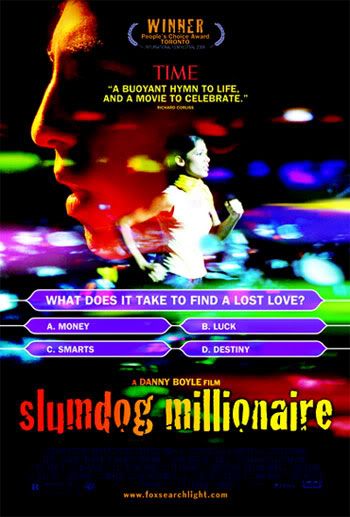
Slumdog Millionaire (2008)

It is always in style to root for the underdog. Just yesterday, I watched Super Bowl XLIII and cheered for the Arizona Cardinals the whole way through. When the underdog loses, like the Cardinals did, it is never as disappointing as if the favorite loses. Most people just acknowledge that hey, that's why they were underdogs. But when the unlikely party pulls through and shocks everyone, like the Giants in last years Super Bowl, there is an undescribable feeling that takes over, leaving a permament smile on your face and a temporary flutter on your heartbeat. This years Best Picture favorite Slumdog Millionaire is perhaps the greatest individual underdog story ever told, and (sorry Dark Knight) the best movie of 2008 (that I've seen). The story follows Jamal Malik (Dev Patel), an uneducated young man who grew up in the slums of Mumbai. Jamal is a contestant on the Indian version of "Who Wants to be a Millionaire" and is one question away from winning the top prize of 20,000,000 Rupees. The show's host Prem Kumar (Anil Kapoor) is not convinced that this boy from the slums could really know all the answers and secretly has him arrested under suspicion of cheating. During his brutal interrogation, Jamal tells the Police Sergeant (Irrfan Khan) the story of his life, and how his tumultuous relationship with his brother Salim (Madhur Mittal) and his unwavering love for the beautiful Latika (Freida Pinto) taught him all that he knows. Although devoid of caped crusaders and villains in war paint, Slumdog Millionaire is a different kind of hero story that gets my vote for Best Picture.


Believe it or not, Slumdog Millionaire was at one point meant to be a straight to DVD release. If that had happened, the Academy would have had to create a new "Best Straight to DVD Movie Ever Made" category so this movie could win. Initially when I left the movie theater after watching this film, I didn't think it was as great as I do now. But last night, as I lay restless from the heart pumping Super Bowl, I had time to think about the movie more in depth. By the time morning rolled around, I came to the conclusion that Slumdog Millionaire was in fact a fantastic achievement in modern cinema. Danny Boyle, director of such films as Trainspotting, 28 Days Later, and Sunshine, was the man behind the camera for this film, and I'm afraid my limited vocabulary won't be enough to praise his work. What must be acknowledged first is how he captured the heart breaking every day lives of regular people who unfortunately live in delapidated slums. Living in a world where the police will neglect to intervene an attack even after they see a man on fire is just one of the injustices that must be dealt with in these areas. Not to mention the living conditions which can only be described as pits of squalor. An aerial shot of miles of tin roofs is a disheartening reminder that there are not just a few people subjected to these conditions. Boyle brings these truths to the screen in such a way that no human can turn a blind eye to these facts anymore. I would love to take some of the heartless people from my school to see this movie and try to show them what spoiled and ignorant brats they are. Slumdog Millionaire never loses credibility thanks to Boyle's magnificent directing. He effectively mixes past and present tense without turning the movie into a disjointed mess. Credit should also not be taken from writer Simon Beaufoy, whose screenplay is perfect and never hits a sour note. The collaboration between Beaufoy and Boyle makes every moment of Slumdog Millionaire one to be remembered.


But an underdog story isn't truly great until you have a good underdog to root for. It is here where Dev Patel, Ayush Khedekar, and Tanay Chheda rise to the occasion. Each actor portrays the slumdog Jamal Malik at different ages and each find a way to grab at your heart. While Patel is the oldest and is receiving most of the noteriety surrounding Slumdog Millionaire, it is Khedekar, who played the youngest Jamal, that I was most intrigued by. I am not often impressed with child actors, but Khedekar is a bright exception. He accomplishes a feat that not many professional adult actors have the ability to pull of convincingly: emotions. Khedekar displays a wide range of emotions from excitement to sadness, and love to anger. He and co-star Rubiana Ali (youngest Latika) bring more romantic chemistry to the screen than quite a few professional stars (Katherine Heigl and James Marsden in 27 Dresses, Dane Cook and Jessica Alba in Good Luck Chuck, Orlando Bloom and Keira Knightley in all three Pirates of the Caribbean films). Patel is merely the icing on the cake, drawing the viewer in with an innocent face and a sterling performance.


As I mentioned earlier, the appeal of Slumdog Millionaire lies in it's brilliant underdog tale. It is unknown whether or not this film will be considered truly great in the future, but for now, one thing is for certain. Slumdog Millionaire is an outstanding achievement in entertainment and regardless of whether you prefer summer blockbusters over Oscar contenders, you will like this movie. If you are worried that 20% of the film is spoken in Hindi and you won't enjoy reading the subtitles, Danny Boyle has you covered. Rather than just put the words up on the screen, he masterfully finds a visually beautiful way to keep you in the loop. At a reasonably quick two hours, you won't ever feel let down by Slumdog Millionaire, I guarantee it. My rating (10/10)


P.S. - Stay during the credits for an amazing choreographed dance sequence involving every member of the cast.


The Machinist (2004)

Insomnia is a devious little parasite. It can be caused by any number of things, such as an emotional trauma, withdrawal from drugs, or even just jet lag. Serious sufferers can go weeks without sleep, causing major damage to the person's ability to function. The accepted cure for insomnia is not any type of medicine, but rather a type of therapy. First you must pinpoint what exactly is causing someones insomnia, and then work to relieve that issue. Trevor Reznik (Christian Bale) is having some problems with insomnia. He has gone over a year without sleep and there does not seem to be a reason why. His lack of rest has left him an emaciated shell of a man who's more bones than body. Reznik spends his sleepless nights either with his call girl girlfriend Stevie (Jennifer Jason Leigh) or at an airport diner talking with waitress Marie (Aitana Sanchez-Gijon). During the day he works at a factory operating heavy machinery, an activity dangerous in itself, made even more so by his drowsy state. When new worker Ivan (John Sharian) distracts Reznik while he is helping a friend, a terrible accident occurs that Trevor feels he is being blamed for. His paranoia continues to feed on the accusations from his co-workers that Ivan does not exist. As Reznik's self destructive search for the truth encompasses his life, he starts to learn more than he bargained for. Although not particularly original, The Machinist is a unique thriller deserving multiple viewings.

Christian Bale is without a doubt one of the best actors of his generation. He has consistently taken on various challenging roles and more often than not he is successful. In movies like American Psycho, Batman Begins, The Prestige, Rescue Dawn, 3:10 To Yuma, and this summer's Oscar snub The Dark Knight, Bale time and again takes his roles to the next level and beyond creating unforgettable performances. But what strikes me the most about him is his absolute dedication to his roles. In American Psycho, Bale was in peak physical condition, so much so that when he had to film a shower scene, every woman working on the movie dropped by to watch him. For his role in The Machinist, Bale dropped to a sickly 120 pounds, grossly underweight for his 6 foot frame. That wasn't enough for Bale, who claims to have wanted to drop to 100 pounds, but the filmmakers wouldn't allow him to for health reasons. It got to the point where filming running scenes was painful for him, because he had no leg muscles left. Just one year after The Machinist, Bale starred in Batman Begins, a role that required him to be, once again, in top physical form. Bale put back all his muscle and then some, causing the filmmakers to force him to lose some weight again because he was getting too big. But along with his dedication, Bale's acting ability in The Machinist is impressive. As his character turns from paranoia to hysteria, Bale gives a pitch perfect performance that will ensnare you in his world.


It is very easy to become involved in The Machinist. Director Brad Anderson does a masterful job of giving this film not only just a distinct look, but a feel. The primarily grey and dull atmosphere hypnotizes the audience, drawing them in to the unusual world. It is as though we are looking through the eyes of this poor sleep depraved man and directly at the crumbling world around him. Anderson's expert handle on the pace of the film allowed no room for low points, and only a continuous increase in suspense as every scene passed. The combination of Anderson and Bale brings The Machinist to a status above ordinary, which helps the fact that the script was not exactly fresh. Although not a direct rip-off of any particular film, The Machinist shares numerous elements with numerous films. The twist ending is especially affected by the stale writing because it has been seen countless times. Screenwriter Scott Kosar had only written one film before, and it was the god awful remake The Texas Chainsaw Massacre. After The Machinist, Kosar penned another remake of The Amityville Horror. When one spends much of his efforts copying and pasting the work of others, it obviously seems to get in the way of their original writings. The story is not totally killed by these cliches, but it is definitely damaged.


The Machinist is an above average thrill ride that is guaranteed to entertain. There is no chance to get bored thanks to the stunning direction and solid performances from the entire cast. It's only downfall being it's predictable ending and altogether average screenplay, The Machinist is not an achievement to be missed. My rating (7.5/10)


Below are pictures that show Christian Bale's ridiculous weight transformations for his roles.


Left: The Machinist

Right: American Psycho


Gran Torino (2008)

I am not a racist. I believe that every race has their benefits and shortcomings, including my own. But who among us can say we haven't laughed at some racial humor in our lives? I like to think that it's healthy to poke fun at everybody once in a while, just as long as it is in good fun and not meant to be offensive. Comedians everywhere do impersonations of different races that we are not ashamed to laugh at. Racism in movies and television can be somewhat different depending on how it is used. American History X was a fantastic film that focused on how racism can destroy lives, and it was absolutely nothing to laugh about. However, racism in a movie like Borat is meant to inspire laughter and not to be taken seriously in any sense of the word (although I guess you could say Borat was more anti-Semitic than racist. Same point though). But with all the professional comics out their, who would have thought that the best racial and insult comedian to ever live was Clint Eastwood?

The content of Gran Torino is in no way a comedy. It is the story of bitter Korean War veteran Walt Kowalski (Clint Eastwood), who after losing his wife now lives alone with his dog Daisy. Walt spends his time fixing things around the house, drinking beer, and caring for his beloved 1972 Gran Torino. At the wishes of his late wife, local priest Father Janovich (Christopher Carley) checks up on him every now and then, but Walt, who has trouble connecting with own children, wants nothing to do with him. But if you asked Walt what annoyed him the most about his life, it would be his neighbors. We've all had neighbors we didn't care for. Maybe they didn't clean up after their dog in front of your house. Maybe they borrowed your lawn shears and never returned them. Walt's reason? They are Asian. An entire neighborhood of Hmong people surround Walt, and he is not happy about it. When his next door neighbor's teenage son Tao (Bee Vang) tries to steal his Gran Torino as a sort of gang initiation, the family forces their son to work for Walt as penance. As Walt gets to know Tao and his family, his old ideals begin to fade, and he even takes Tao under his wing, teaching him life lessons and protecting him from the gang that is after him. Gran Torino is a film that defines character growth and is richly entertaining, albeit not always for the right reasons.

The single driving force behind Gran Torino is its director and star Clint Eastwood. Without his presence, this film would have suffered vastly. Although Eastwood's age prevents him from bringing physical charisma to the screen, his verbal deliverance of insults and lessons make his performance unique and interesting. The septuagenarian actor claims Gran Torino will be his final film in front of the camera so he can stay behind the camera, and I feel this performance is one Eastwood can go out on happily. Whether he wanted to or not, he brought forth a deadpan comedy that would make Vince Vaughn proud. A single scene where he would walk through the house of a Hmong family and throw around racial slurs as though nobody was there provided for more laughs than all of Jason Friedberg and Aaron Seltzer's movies put together. (Although it can't be hard to top two laughs). Eastwood's performance was thoroughly entertaining, but because it was for the wrong reason, I can't really say it was great. When Eastwood wasn't rolling me in the aisles, he spent his time growling at people and just looking genuinely angry at everything. Even when his character shows kindness he still ends up looking like he wants to hurt me. The accomplishment in Eastwood's performance lies solely in how he convincingly made his character turn from a miserable grouch to a kind-hearted hero. He also taught me about four new insults I plan on dispensing to my friends.

Without the professionalism of Eastwood, Gran Torino falls short on every mark. The entire Hmong supporting cast was comprised of rookie actors who have never been in a movie before, with the exception of Doua Moua, who played the gang leader. Perhaps by surrounding himself with the talentless hoi polloi, Eastwood thought his guttural mumblings would make him seem like the mumblings of a Best Actor candidate. Nice try, Mr. Eastwood. Gran Torino also becomes unsure of itself as it plays on. At first you feel the movie will primarily be about Walt protecting Tao from the gang, while at the same time learning the lesson of tolerance. But the film ends up abandoning the gang aspect and just focuses on Walt and Tao's relationship for most of the movie. Then at the end, the gang, after lying dormant for about 45 minutes, re-enters and steals the ending of the movie. I acknowledge that this could be argued as making the movie "dynamic", but I choose to think it makes writer Nick Schenk indecisive. However, Schenk's screenplay is not at all bad. There were several scenes that were written very well and kept the movie entertaining. Specifically, keep an eye out for the scene when Walt teaches Tao to interact "like a man" with his barber Martin (John Carroll Lynch).

Gran Torino is a tolerable 116 minutes that is mostly held up by star Eastwood. I have to reiterate that although I am recommending this movie, it is not because it was the deep, searing drama it looks like. I actually suggest cutting off the final 20 minutes and changing the title to Clint Eastwood Insults People. If they did that, they could've won the Golden Globe for Best Picture Comedy or Musical. Actually, if they made it a musical, this could go down in history as the greatest movie ever made. But it isn't. The only dramatic aspect where Gran Torino succeeds is in spectacular character development. Everything else is overshadowed by comedy. My rating (7/10), for all the wrong reasons.
NOTE: I'm aware of the fact that this movie is not really a comedy. I just found the content of this movie to be extremely comical when it was supposed to be very serious. That was my point. So if you noticed that I tagged it as a comedy, please don't think I'm an idiot.

The Wrestler (2008)

I stopped watching wrestling when I was about 12 years old. My excuse was that I had grown out of believing that what I was watching was real and not completely staged. Watching grown men in their underpants pulling punches at each other didn't provide me with any entertainment anymore. Until recently I didn't understand how physically grueling it is for wrestlers, and how much of an emotional impact it can have on their lives. I never took the time to think of what their lives would be like in 2o years, when they are forced to give up the spandex and take normal jobs. The Wrestler is an answer to that very question. Mickey Rourke plays Randy "The Ram" Robinson, who in his hay day was one of the greatest wrestlers of a generation. But 20 years later, Randy finds himself living in a trailer park alone and working at a convenience store part time. Still, he wrestles as much as he can despite his increased age. But after a particularly bloody battle, Randy suffers a heart attack, leaving him incapable of handling any more matches. Having to give up the one thing in life that he loves, and also loves him back, Randy falls into a depression. He looks to his only friend, a stripper named Cassidy (Marisa Tomei), for some guidance. But he knows, the only way he could ever be happy is if he can continue wrestling. The Wrestler is a deep and emotional accomplishment that several times brought tears to my eyes.


If you are a fan of the WWE and want to see this film because you expect a documentary on wrestling, you should go ahead and check yourself at the door. Much like the fighting took a back seat to anarchy in Fight Club, wrestling is a distant second to the true core of this film: a man searching for someone to want him. I could think of no actor better suited to this role than the unconventional Mickey Rourke. Early in Rourke's acting career, he did manage to garner attention from critics for his roles in The Pope of Greenwich Village and Barfly. But Rourke was a volatile man and was said to be out of control on set. He was also probably very confused because in his career he has turned down lead roles in Pulp Fiction, The Silence of the Lambs, Rain Man, and The Untouchables. In 1991, Rourke left acting to pursue a career in professional boxing. Over a four year span Rourke was never defeated and had only one draw. Upon his retirement in 1995, Rourke never really made big impact in his transition back to acting. But now in 2008 his luck seems to have finally arrived, and he gives the performance of his career in The Wrestler. Nicolas Cage was originally cast to play Randy, and thinking about that makes me laugh. Cage is a cool guy, but he would have destroyed this movie. Rourke was able to bring so much heart to this role, possibly because him and Randy are practically the same person. But Rourke proves he is no wash up, as he made my eyes well with tears numerous times. One particular scene I should highlight is when Randy reunites with his estranged daughter Stephanie (Evan Rachel Wood). Randy pours his heart out to his daughter, and the result is a powerful scene that would make a rock's heart skip a beat. Rourke won a Golden Globe for his performance and has now been nominated for a Best Actor Oscar. I would not be surprised if he won.


One of the many things that makes The Wrestler work is the stellar direction of Darren Aronofsky. There are so many scenes that I can remember that really struck me beautifully. My favorite was one continuous shot that followed Randy from his bosses office to the meat cutting station in the back of the convenience store where he works. As he walked, the camera slightly bounced up and down as if their was just a man with a handicam following him. During this long walk, a crowd is heard cheering, perhaps waiting for the arrival of Randy. He finally gets to the doorway of the station and stops, and the cheers grow louder. But as he steps through into the room, the crowd noise disappears, and he proceeds to perform his menial job. This exemplifies how overtaken Randy's life has become by his wrestling. The stark contrast between walking through a crowd of people who are screaming your name and then putting on latex gloves and a hairnet really drives the idea of the movie home.


The people in Randy's life, or the lackthereof, provide an extra dose of sentimentality without becoming too maudlin. In keeping with the theme of being washed up, Marisa Tomei plays a stripper passed her prime that doesn't get much business outside of Randy. I find this to be the only unbelievable part of the movie, because even though Tomei is 44, she is not even close to being passed her prime. She proves it in every single scene she is in. But Tomei is so much more than just the nude sidekick in this film. As Randy's only companion, she brings the only sympathy for him to the movie and does a great job doing so. Recently she grabbed an Oscar nomination for Best Supporting Actress for her role, an honor which I'm not so sure was deserved. She gave a great performance, but I didn't see anything award worthy from her. However, I do credit her character with creating some of the most memorable moments in the film. It is her idea that Randy try and contact his daughter Stephanie after his heart attack. In taking her advice, some truly fantastic scenes followed. One scene involves Cassidy helping Randy buy Stephanie a gift at a vintage clothing store. It is here that Randy first interacts with Cassidy outside of the strip club and the two get to know each other as people rather than her being a stripper and him being a customer. Evan Rachel Wood gives a strong turn as Stephanie, who was abandoned by her father and is now aggrevated with his return to her life. Wood is at her finest when she is telling off her dead beat father for the last time, and sends a pang of heartache to the viewer. Her attitude only makes you feel worse for poor Randy, who is genuinely trying to reform.


I didn't know what to expect from The Wrestler. My friend who is a big Mickey Rourke fan built the movie up so high when he told me about it that I was afraid it wouldn't be as effective when i finally watched it. Luckily it was, and I am so grateful I gave it a chance. Whether you are a fan of wrestling or not, it does not matter. The journey you go on to follow this man through his many trials will break your heart and make you appreciate all the things you have in life. My rating (9/10)

Movies given a 10/10

  • Milk
  • In Bruges
  • Slumdog Millionaire
  • The Dark Knight
  • Iron Man
  • No Country For Old Men
  • The Shining
  • A Clockwork Orange